Project Hail Mary: From Space to Connection
- Dalila Flores Castillo
- 26 mar
- 5 min de lectura

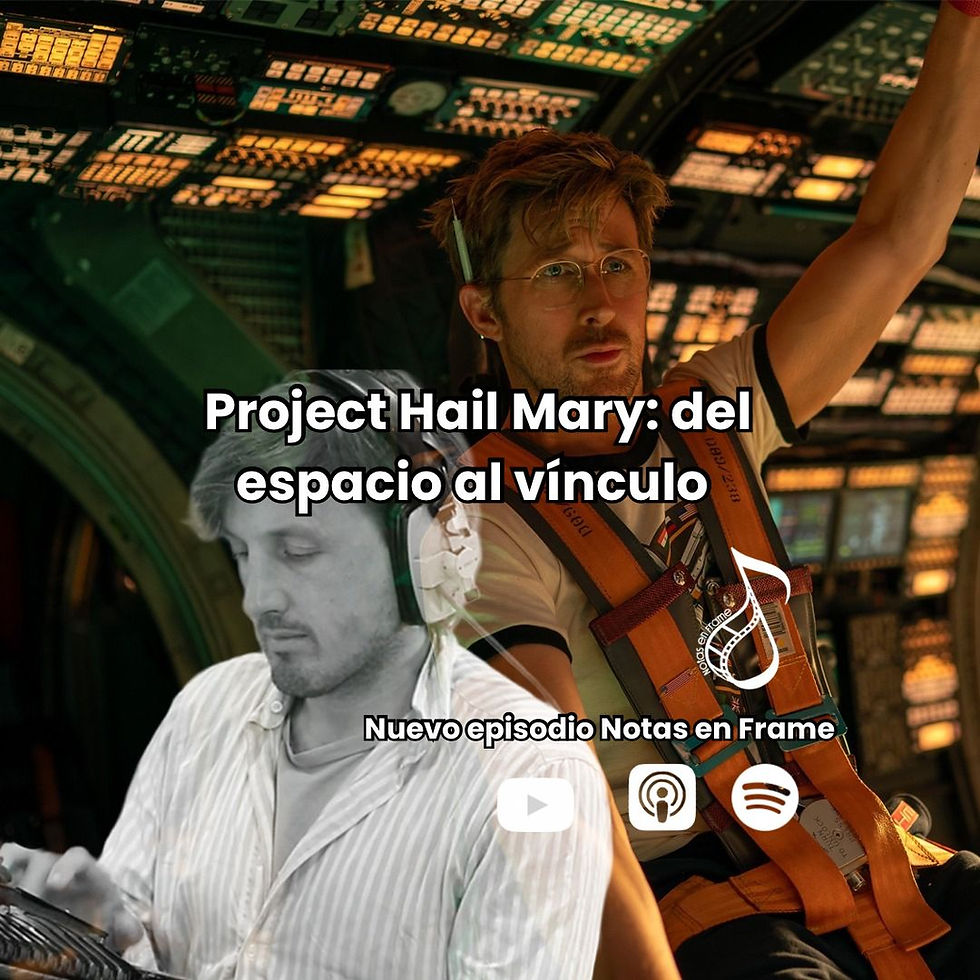
This week, we talk about Project Hail Mary.
It had been a long time since a film moved me in the way this one did. I genuinely did not know what to expect when I went to the cinema. Directed by Phil Lord and Christopher Miller, with music by Daniel Pemberton (whom we discussed earlier in the podcast, the same composer behind Materialists) this film presents an especially interesting whole.
The film, as a whole, feels like an ironic journey: the voyage into outer space becomes, instead, a journey inward…into what it means to be human, into humanity itself.
As always, I will attempt to remain focused on the music. The soundtrack offers two hours of music across 38 pieces. In composing this score, there was a clear intention to separate the sounds of space from those of humanity; however, these ultimately merge, constructing the film’s central narrative: the blending of what makes us human and our relationship both with one another and with forces external to society (be it the unknown, the Earth, or other planets).
The music begins from the most primitive unit of the human being and the sounds that emerge from it: the body, percussion, the voice. This is clearly present in pieces such as “Water Based,” “Humanity,” and “Box in a Box,” which appear early in the album. For the spatial dimension, we encounter a greater use of synthesizers, as well as the Cristal Baschet, an instrument we have previously discussed, particularly in the episode on Conclave. Its inclusion here is especially interesting, as it is used to evoke “the divine,” that which escapes the tangible. It is also difficult not to draw a connection with the well-known soundtrack of Interstellar, specifically in the piece “You Were Loved,” which is compelling to analyze given that both narratives unfold largely within a similar setting.
The use of this sonic resource makes sense in a film that conceptually places us within the unimaginable vastness of outer space. What does it mean that our ears associate this sonic quality with that which we cannot quite “earth-anchoring*”? (yes, I said “earth-anchoring”). It may point toward an attempt to identify with the fact that life contains an element that escapes our control, something intangible, bodiless, and not yet fully comprehensible through rational means.
*I use the term “earth-anchoring” in the absence of a direct English equivalent for the Spanish verb “atierrizar”: understood here as the re-anchoring of experience within material, situated and perceptual conditions of existence.
Our hearing, and our perception of space and time, recognizes these sounds as part of an imaginary that defines us as human: there is something inexplicable, something that escapes. Otherwise, why do we immediately understand the message carried by these sounds? Why does it feel natural to associate them with these themes? Who established this seemingly natural relationship between these sounds and experiences of confrontation and reflection? This, perhaps, has been normalized through a cultural construction that we have collectively learned to recognize.
Fully aware of this, Pemberton employs these elements to connect us with the atmosphere the narrative seeks to build, while simultaneously directing us toward questions about the human capacity to connect with this “void.”
This film, and its music, speak of connection, connection with those profound dimensions that cannot always be conceptualized in numerical or objective terms, and with the deep virtue of bonding, both with others and within ourselves.
There are two pieces that stand out as the climax of this intention: “A Moment” and “Life Is a Reason.” The composer himself has described “A Moment” as one of his favorite cues, considering it a piece that truly immerses the listener in the sensation of an expansive infinity.
While these pieces mark an important emotional shift, it is essential to focus on the longest track in the album: “Time to Go Fishing,” which runs for 7 minutes and 10 seconds. It is here that a crucial resource becomes most evident: silence. The piece originally began with the intention of featuring only a constant percussive pulse; however, the person responsible for the musical decisions (an important detail) chose to modify this request, introducing additional sonic elements around that pulse, such as the sound of pipes recorded on a phone in a friend’s home.
The piece evokes the sensation of time, of a clock; in fact, attentive listening reveals the presence of a cowbell sound. It begins with a clear percussive base, gradually incorporating new elements, much like what follows a decision (precisely what unfolds on screen). At a certain point, the screen falls silent, showing only space. Silence becomes central to the experience. It appears in order to allow questions about the narrative to emerge. Silence operates as an expansive element, as a trigger, and, in doing so, it becomes a narrative anchor.
Music and sound thus establish the points within a narrative trajectory where the audience’s attention is anchored, placing it at the center of the questions the work seeks to provoke.
Typically, films about space aim to leave the audience with a sense of planetary smallness. However, despite this expansive silence, Project Hail Mary does not function in that way. The combination of percussive and vocal elements used to represent humanity, alongside the sensory qualities embedded in the chosen instruments, suggests instead the power of connection, of relationships.
Even this expansive silence reinforces that idea. How? Music organizes these moments of expansion in relation to the presence of the film’s central bond, functioning almost as an “activator.” In doing so, it redirects the experience: what expands, what becomes greater than infinity itself, is the bond.
Music thus becomes direction, magnitude, and meaning.
Moving toward the end, the album includes two pieces with the same title: “Amaze Amaze Amaze.” In the first version, the music approaches the bond as a form of play. And what lies behind play? A fertile space for creativity. Encounter enables creation. This invites reflection on our own relationships: behind every connection lies the potential for transformation, for the creation of identities, ideas, and traces. Bonds become imprints in and for our lives, both individually and collectively.
The piece that closes the film is the second version of “Amaze Amaze Amaze.” Here, percussion returns as the point of departure, while instruments and motifs from the entire musical journey gradually reappear. The triumphant tone of play resurfaces, yet percussion stands out, suggesting something along the lines of: at the end, we remain (percussion and voice as humanity); at the end, we are in constant motion (synthesizers and additional textures); at the end, through bonds, we become infinite universes in constant expansion.
These final moments led me to think about the concept of the “coda” in music: the concluding section that provides a sense of closure. If we think of it in these terms, the importance of connection is shaped across a trajectory, much like our own encounters.
So I leave you with a question: if this film and its music build toward this expansive coda of connection…what coda do you choose for your relationships?


Comentarios