Timeless Innocence: A Historical Superpower
- Dalila Flores Castillo
- 20 oct 2025
- 4 min de lectura

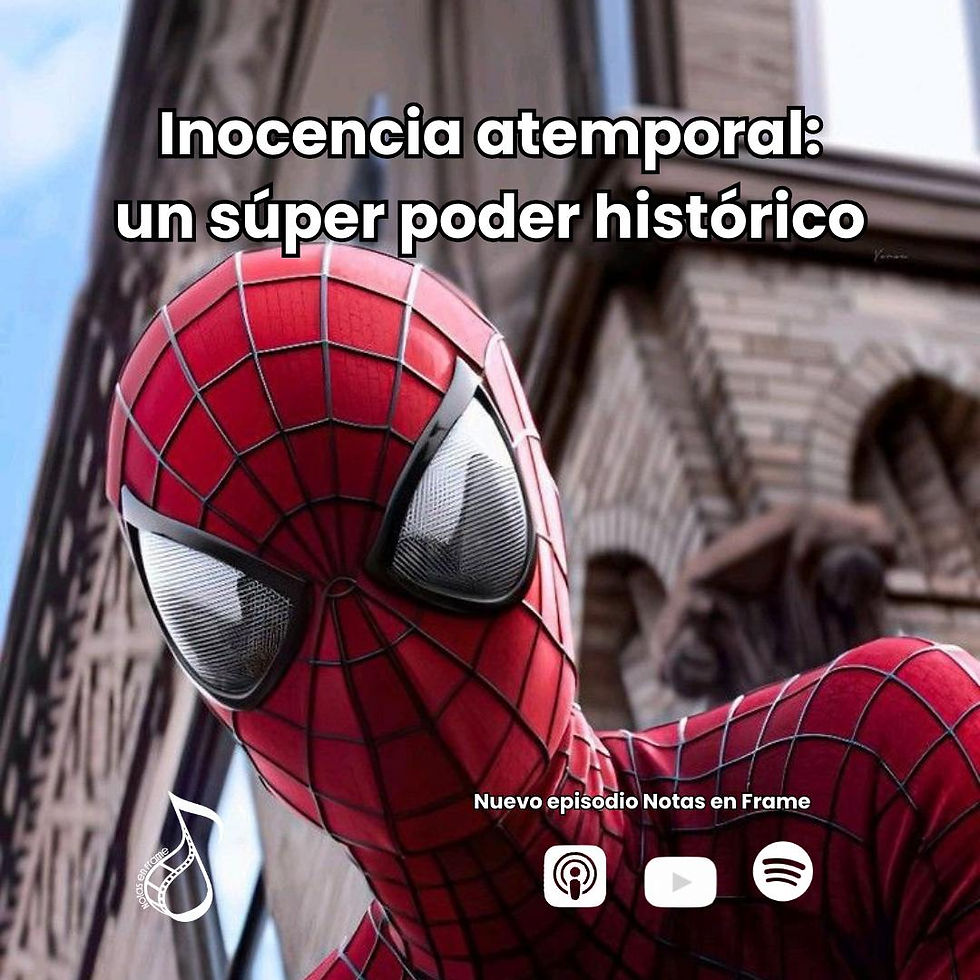
This week’s episode dives into nostalgia — and I have to confess, I thought about this week’s main theme for quite a while before the answer struck me like lightning… or rather, wrapped me like a web, haha.
This week’s episode is dedicated to another emblematic character of popular culture.And the reason is simple: I’ve been seeing him all over social media lately, since the new installment is currently being filmed.
Spiderman is one of the most beloved characters in the Marvel universe, and his music is no exception.
Going back a bit in time: this character made his first appearance in 1962, and his debut in television came with the Spiderman series in 1967.This series is essential to the emotional compass of this character, whether or not you followed it in real time. Paul Francis Webster and Bob Harris were the original composers of the emblematic Spiderman theme, while the score was written by Ray Ellis, saxophonist and record producer.
In cinema, his first official appearance came in 2002, under the baton of Danny Elfman, who also composed the score for the 2004 sequel. Elfman, with his dark and mysterious style (almost like a gothic comic in sound) gave Spiderman an unmistakable musical identity.
Then came the 2012 reboot, with Andrew Garfield as Spiderman and directed by Marc Webb, featuring music by James Horner.This same Spiderman continued two years later, in 2014, with a second installment (this time scored by Hans Zimmer.Yes, that’s right) Hans Zimmer has also been part of Spiderman’s musical history (even though many don’t realize it).
In between, the franchise ventured into an animated version, considered by many as one of the best representations of this character (allow me to disagree).That soundtrack was composed by the same musician from our previous episode — Daniel Pemberton.
This soundtrack is quite interesting: unlike the previous ones we’ve discussed, it stands out because it leans not only on the original score — that is, the composed music that creates atmosphere and codes — but also on original songs by contemporary artists, often well-known in pop culture.That part of the job belongs to the music supervisor — but we’ll talk about that another day.
For this case in particular, we have songs performed by artists like Post Malone and Lil Wayne, to name a few.(And if you’d like, we can make a full episode just about that, because I think it’s a super common confusion in this field.)
A Return to the Core
Later on, due to rights, budgets, and internal narrative shifts, Spiderman returned with a third major production and a new face: Tom Holland.For this Spiderman, we find a constant in the musical direction — Michael Giacchino.
Giacchino took on the task in a landscape where there was already a deep emotional bond with the character — spanning at least four generations.
In Homecoming, Giacchino decided to bring back the classic intro from the 1967 series — a kind of “where it all began.”
I find this fascinating, because when a character has been embraced across so many historical stages (and I do mean historical stages), returning to the intro feels like a return to the center — or, if we want to romanticize it a bit, a return to origin.It’s a temporal marker, a statement — and after so many political disputes surrounding the character, it truly feels like a victory.
None of the three previous reboots did this.And remember: Tom Holland’s Spiderman is the one who fights alongside other heroes in the mythical Avengers films.So this musical choice, beyond nostalgia, carries inherent political and cultural meaning.It’s saying:
“Spiderman is still a symbol. He still belongs to the collective.”
That’s the magic of music as an emotional anchor.
The Sound of Innocence
As I always say, here we focus on the music — so let’s keep our lens there, on the emotional framework that surrounds this character.
Spiderman was born in a New York of the 1970s — a city full of jazz and cultural fractures.That’s why I love thinking of jazz as a perfect metaphor for him — because I truly believe it’s part of him.
Jazz has always been defined by its unpredictable structures — rhythms and melodies that are surprising but mostly joyful.
When I studied music, I remember jazz being placed in a different department, a different category than the “traditional” ones.What I often heard in the hallways was that jazz carried a different kind of difficulty — one rooted in creation, in the pleasure of the new, in the potential of curiosity.
In essence, like everything born from curiosity, jazz carries the mark of innocence — of faith in creativity, in expression, in “art” and the aesthetics that rise from our most playful, innocent, and profound instincts.
Spiderman also represents that by himself.
For his creation, Stan Lee admitted that the character was born out of an attempt to connect with a younger audience.Let’s remember: Peter Parker is a teenager from Queens — today one of the most culturally diverse neighborhoods in New York. And this isn’t from a book or article — I’ve lived there.
Spiderman preserves the freshness of someone who breaks molds — the creative and historical innocence that reminds us that innocence is often the sixth sense that protects bravery, vulnerability, and fracture.
The Sound of a Declaration
Bringing back the iconic 1967 intro in a 2025 world — accelerated, superficial, and trapped in short-term thinking — is more than a nostalgic gesture: it’s a declaration.It says:
“The essence is still here.”“And yes, from here, structures — and why not? — superpowers can still be built.”
That’s why, and I find this a brilliant move, the playful pizzicatos Giacchino includes in his score aren’t mere decoration — they’re a sonic manifesto.
Combined with the chase scenes and the iconic moments, those details whisper a sense of innocent play — a way of reminding us that, even amid all the noise, faith in innocence remains a superpower.


Comentarios